Saturday, January 28, 2012

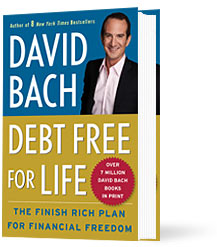
"Debt Free for Life" by David Bach - Book Review

Debt Free for Life: The Finish-Rich Plan for Financial Freedom provides a series of actionable steps for debtors to reclaim their finances by eliminating their debt, in addition to conveying a wealth of information about common forms of debt. I prefer to write book reviews from an objective and factual standpoint, but this book has done so much for me personally that this review may inevitably sound like a testimonial.

In Debt Free for Life, author David Bach makes it clear that there is no "magic pill" to take away consumer debt, student debt, mortgages, auto loans or any debt that causes people to struggle. He takes a hard-nosed approach to laying out the facts in a clear and concise manner, showing that debt can only be eliminated through proper planning, hard work and dedication. However, in addition to being realistic about the difficulty of working one's way out of debt, Bach provides a clear roadmap to success, guiding readers through the process of creating a custom-tailored plan to systematically reduce their debt while avoiding unnecessary expenses.

The first step to financial freedom presented in Debt Free for Life is to truly know your enemy, which means knowing (and writing down) everything about your debt. After reading the early chapters, I created a spreadsheet laying out exactly who I owe money to, the exact balance of each debt, the individual interest rates and minimum payments, as well as creating a schedule of due dates to ensure I am no longer hit with late-payment penalties. After guiding readers through this exercise, author Bach outlines his famous system for creating a plan to eliminate one debt at a time while never falling behind on any others.

In addition to the action steps presented in Debt Free for Life, David Bach calls upon his years of experience as a debt coach and author of such titles as The Automatic Millionaire and Start Late, Finish Rich to explain the intricate details of the most common forms of debt, including the advantages and disadvantages of each and common pitfalls experienced by debtors in each area. After finishing this book, I understand my debt on a fundamental level, and I can personally attest to the power of Bach's DOLP method of debt-reduction, as I'm watching my own debts shrink each month without being replaced by new ones.

“What can be added to the happiness of a man who is in health, out of debt, and has a clear conscience?”
-Adam Smith
Share

Friday, November 25, 2011

Burger King and the New BK Crown Get it Right

Much of business ethics deals with the way in which organizations conduct business and interact with their various stakeholder groups. Not much is said about what I like to call "product ethics" -- the ethical implications of products themselves, apart from the ways in which they are produced, transported or sold. Burger King's new BK Crown program serves as a shining example of solid product ethics.


Burger King's new kids' meal, named the BK Crown, breaks all the rules of fast-food children's menus. For decades fast-food chains have contributed to shockingly high rates of childhood obesity and health-related issues in children who are fed fast-food poison throughout their developmental years. Rather than pumping as many calories and as much sugar as they can into children, Burger King will now serve healthy meals consisting of chicken products, fruit and white milk (as Jamie Oliver does a fist-pump) -- all part of a truly balanced diet. Not content to stop at excellent nutrition, a BK Crown meal includes brain-stimulating games and puzzles, and the opportunity to choose which of three ways Burger King will donate to charitable causes.

Let's not miss the deep implications of this product package. Left to themselves, American children will invariably choose the most unhealthy foods and the least educational activities possible, and will act out of purely selfish motives most of the time. This kids' meal introduces children to the possibility of eating healthy, having fun while learning and giving thought to needy causes around the world. This is product ethics at its finest. I bought a few Whoppers this week (which I have not done in many years) simply to show my gratitude for a fast-food company that is genuinely trying to make a positive difference in American society.

In what ways do your products and services truly serve ethical or progressive purposes?

Further Reading:
BK Crown 
USA Today: Burger King Ups the Ante in the Fight for Kid Customers

Share

Thursday, April 14, 2011

Western Oil Politics in Libya

Virtually every Western oil company with a strong presence in Libya has reacted the same way throughout the Libyan people's struggle against Moammar Gadhafi: with tentative silence. A recent article from Bloomberg Businessweek reveals that major oil companies are playing politically safe in Libya, not wanting a burn bridges with either Gadhafi or the new rebel government. 


In business, there is such thing as taking a temporary hit to profitability to invest in a stronger future by reaching out to customers in truly meaningful ways. To me, Western oil companies' wishy-washy reaction to political turmoil in Libya will only hurt them in the end. Oil companies seem to be uncertain of whether Gadhafi will remain in power or not, despite the consistent voice of the Libyan people, the unified cause of nations around the world and new EU sanctions on oil companies doing business in Libya. The problem is, oil companies seem to be completely ignoring the ethical and human rights implications of Gadhafi's possibly remaining in power. 


The best thing for these oil companies to do would be to treat the rebel government as if they are the only legitimate ruling party in Libya, helping to fund their political and military actions against the old regime in return for first rights on Libya's most lucrative oil fields. 


The links below will shed light on just how terrible of a partner Libya's old regime has been to Western oil companies over the last half-decade. In my opinion, oil companies should be just as vehemently opposed to Gadhafi's regime as the people of Libya. They are in a unique position to turn the tide of battle in the people's favor, securing a strong, positive reputation among the people of Libya for years to come, but they can't seem to see past short-term revenue impacts to understand the long-term value of becoming a major player in Libya's liberation. 


What other ways can Western businesses gain competitive advantages by supporting the Libyan people's struggle against a regime whose time has long expired?


Further Reading
Bloomberg Businessweek - Where Has Libya's Oil Gone?
Wall Street Journal - For West's Oil Firms, No Love Lost in Libya
Monsters and Critics - French, US, Canadian Oil Ventures in Libya Hit by New EU Sanctions

Share

Tuesday, March 29, 2011

Creative Advertising Tactics From ABC

As a marketing major, I've always had a critical eye for marketing strategies, especially advertising. I see a ton of advertisements that make me shake my head in dismay, either thinking, "Someone actually got paid for that?" or, "That actually made it past the brainstorm stage!?" Rather than sharing my rants about crummy advertisements, I would much rather share examples of advertisers who "get it" and do things right.

One area I'm particularly touchy about is forced advertisements on web videos. As a child of the 80's, I am accustomed to viewing any video I want online without being forced to watch television-type advertisements. I feel that changing the web video experience to resemble the television viewing experience is a terrible idea from a customer satisfaction standpoint.

Last night I stumbled upon an interesting and innovative way to solve this problem. ABC's web broadcast of its new show Secret Millionaire features an ingenious way to expose viewers to advertisements without interrupting their viewing experience. When a viewer pauses the video, it automatically exits fullscreen mode and displays an advertisement prominently where the video would otherwise be. When the viewer clicks "play", the ad disappears and the video resumes. This virtually guarantees that the ad will be seen by any viewer who clicks "pause," since they will have to look right at he bright ad to click "play" again. It also avoids interrupting the viewing experience, which gives viewers more positive memories of the show. It's a win-win-win tactic for the network, the viewers and the advertisers.

Unfortunately, after claiming the show would be presented with "limited interruptions," ABC included four commercial interruptions for the roughly 45 minute broadcast--nearly one every ten minutes. I'm not here to rant, however. Just imagine what the video would be like if it only included the pause-break ads without the forced interruptions!

How else can advertisers use creativity rather than brute force to gain meaningful exposures?

To view the episode I watched that gave me this breakthrough, check out Secret Millionaire online.

Share

Wednesday, March 9, 2011

A New Type of International Partnership

I was reading an informative article from The Economist today which discussed the trend in developing economies to support large conglomerates, such as The Tata Group, which hold a wide range of unrelated companies from around the world. The article got me thinking about international business partnerships and a new way to form powerful multinational companies.

Traditionally, companies are formed within a single country. Companies grow to an international scale by exporting, licensing, forming strategic partnerships or building foreign subsidiaries. Or, companies from different countries can merge to form new, multinational entities.

As businesspeople and students from around the world continue to interact more with each other and, and as experienced businesspeople's contact lists more frequently include counterparts from foreign nations, I foresee a time in the not-too-distant future where entrepreneurs from geographically diverse areas of the world build companies together from day one.

Imagine a new technology company, for example. I can see one partner living in India, in charge of customer support and product design; another partner living in Mexico, in charge of manufacturing and logistics; and a third partner in the Netherlands, in charge of marketing and finance, with the company organized in a fourth country, like the United States, that offers a favorable business and political environment.

The first truly multinational partnerships--companies formed by partners living in different countries--could easily spring up in areas such as the European Union of the NAFTA zone, where trade and tourism barriers are virtually non-existant. After that, the sky is the limit.

How might you take your business idea to the next level by adding a partner from a different country?

Further Reading
The Economist: Tata Sauce Share

Tuesday, March 1, 2011

The New Normal For Employees

"The new normal" is a term which, to me, represents the fact that industries and businesses around the world are coming to terms with the fact that indefinite exponential growth is simply not sustainable. Rather than thinking that the sky is the limit for revenue, profitability and volume, savvy post-recession businesses are learning to find sustainable output levels and grow organically over time.

Businesses are now running leaner and more efficiently while using less leverage to fuel growth. However, it seems that it is now employees' turn to face the reality of a new normal. The world watched as government workers in Greece took violently to the streets protesting the extension of the retirement age and cuts to employee benefits. Now we see government workers across the United States taking to the streets demanding that their legally-protected rights to collective bargaining be upheld.

The big picture I see is workers in developed economies refusing to accept anything less than what they are accustomed to. When I spent nearly a year working as a gas station attendant with a Bachelor's degree in 2009 I met a man who said he'd been out of work for over a year. When I asked him how he could have been turned down for every job in the market, he replied "I'm not looking for another job. I'm waiting for my old job to open back up." I fear this represents the attitudes of too many Americans today.

It may be time for employees in developed nations to accept that their income cannot grow exponentially forever. Companies and governments are operating leaner than ever before, while people are spending less and saving more. How can it be avoided that average wages and wage increases will find a new normal? This may come as a shock to a Westerner like myself, but we are going to have to accept the fact that our leveraged race cars, leveraged McMansions, leveraged private school tuition and a wide range of other expenses are simply unnecessary, and can no longer be taken for granted.

Workers in India and China are ready to work hard for wages that would offend the average American, and it's a good bet that our new democratic brothers in the Middle East will feel the same way. If Western workers are going to compete with the international workforce, we may need to stop demanding a week's wages for a day's work.

Here's a business idea to help workers with their new normal: household budget consulting services that charge a percentage of the money they save clients.

Further Reading
The Washington Post: Protests Grow in Ohio as Vote on Union Rights Nears
Pittsburgh Tribune-Review: Riots Mark Greece Protest 


“Democracy divides people into workers and loafers. It makes no provision for those who have no time to work.” - Karl Kraus


Share

Tuesday, February 22, 2011

Export Opportunities in the New Middle East

Libya, Bahrain and Yemen are following closely on the heels of Tunisia and Egypt as the next Middle-Eastern countries to rise up and demand democratic representation. It seems the United States' hushed and extended stay in Iraq has had the effect of introducing democracy to the Middle East in a powerful, unstoppable way.

If things continue the way they are--which they most likely will--the world will soon see a new democratic powerhouse to compete with the U.S. and the E.U. And this new democratic powerhouse will undoubtably have an insatiable desire for Western and European imports as they get on their feet.

The revolution contagion will open up the doors to the Middle East for Western small businesses in more ways than ever before. But before the floodgates open, I'd like to take a minute to make a world-wide public service announcement.

The United States' business world can choose between two routes when demand for imports skyrockets: the traditional method of exporting obesity, gluttony, greed and a dumbing-down of social culture, or a new ideology of exporting products and services designed to improve the quality of life in the Middle East.

America prides itself on exporting Coca-Cola and McDonald's around the world, and at first glance that seems like a success story. A deeper look reveals that we have a tendency to export our most vicious and destructive vices to developing economies like China and India. Companies like McDonald's are not just an American icon, they are a major contributor to a serious obesity epidemic that costs thousands of lives in our country, regardless of how many salads they put on their menu.

Instead of exporting our worst traits, why not export our virtues? I'm looking for solar panel manufacturers, electric vehicle producers, efficient infrastructure designers, social media marketers and other eco- and socially-conscious businesses to offer their products and services to the infant democracies of the Middle East before socially-destructive mega-corporations entrench themselves in Middle-Eastern life.


Let's not export Hollywood, Burger King and Guess jeans to an area of the world struggling to pull itself out from under decades of oppression. Let's export birth control, communications technology and for-profit education. Let's not export diet pills and OCD pills and depression pills and allergy pills; those are our crutches, and the new democracies do not deserve to be burdened by them. Let's export grassroots political campaign experience, renewable fuel technology and our nation's vast range of nonprofit organizations to the Middle East. Let's export our most admirable and useful products, services and cultural aspects to our new neighbors.

What products and services can your business offer to the new Middle East that do not introduce the darker parts of American culture?


Read More
Daily News Pulse: McDonald's is Still a Favorite Around the World
China Business Review: Coco-Cola in China - Quenching the Thirst of Millions


If you build that foundation, both the moral and the ethical foundation, as well as the business foundation, and the experience foundation, then the building won't crumble. - Henry Kravis Share